



Socks That Stay Up: Why Socks Slide Down in the First Place
You're two blocks into a walk and you can feel it: the heel of your sock creeping under your foot, the cuff halfway down your ankle, the fabric bunching under your arch. You stop, pull it up, and it starts again before the next corner.
The short answer on socks that stay up: a sock stays put when the heel is knit as a pocket that grips your heel, the fit through the arch and ankle is snug without being tight, and the size actually matches your foot. Most socks that slide fail one of those three. Very few fail because the cuff isn't tight enough, which is the thing most people try to fix first.
Here's what's actually going on when a sock falls down.
The sock has no real heel. Tube socks are knit as a straight cylinder with no heel pocket. Nothing anchors them to your foot, so every step pulls the fabric a little further toward your toes. It doesn't matter how tight the cuff is; the heel is where a sock either holds or lets go.
The size is wrong. A sock that's too big has extra fabric that bunches and migrates. A sock that's too small is stretched to its limit, and stretched fabric pulls back toward the shortest path, which is down into your shoe. Between sizes, sizing up is almost always the safer bet.
The elastic is done. Every sock has stretch fibers in the cuff and body. Heat, age, and hundreds of wash cycles wear them out, and once the recovery is gone, the sock loses its grip. If a pair used to stay up and now doesn't, this is usually why.
The cuff is doing all the work. A sock that relies only on a tight top band will roll or slide the moment your calf flexes. Grip has to come from the heel and arch first; the cuff is the last line, not the first.
The shoe is part of the problem. A shoe that lets your heel lift pulls the sock down with every step. A low-top worn with a sock that's too short does the same, because there's not enough fabric above the shoe to hold on.
The fabric is slick. Smooth synthetic yarns with no texture and no zoned knit slide against skin and shoe lining alike.

What to Look for in a Sock That Won't Fall Down
Once you know why socks slide, the product description tells you most of what you need. Here's what to look for before you buy.
A knit-in heel pocket. Look for the words "heel" or "Y-heel" or "heel pocket" in the description, or a photo where the heel is visibly shaped rather than a straight tube. This is the single most important feature for a sock that stays up.
Support through the arch and ankle. A band of firmer knit across the arch and around the ankle holds the sock's position on the foot. Brands call it arch support, arch compression, or a fit band. Whatever the name, it's the part that stops the migration.
Stretch recovery, not just stretch. Any sock stretches. A good one pulls back to its shape when you take it off. Shape-memory or recovery fibers in the description are the signal; a sock that comes out of the dryer looking wider than it went in is the warning.
A real size chart. "One size fits most" is a tube sock in disguise. Look for sizes tied to shoe sizes, with separate men's and women's ranges.
The right height for your shoe. A sock has to clear the top of your shoe by enough to hold on. No-show with a low sneaker, ankle or mid with runners, crew with most sneakers and trainers, half calf with boots and high-tops. If you're unsure which height fits which shoe, the height guide walks through it.
Cushioning that's placed, not everywhere. Padding under the heel and forefoot adds grip where you land. Padding everywhere adds bulk that shifts around inside the shoe.
How Strideline Keeps Socks in Place
Strideline's whole construction is built around the sock not moving, and each piece addresses one of the reasons above.
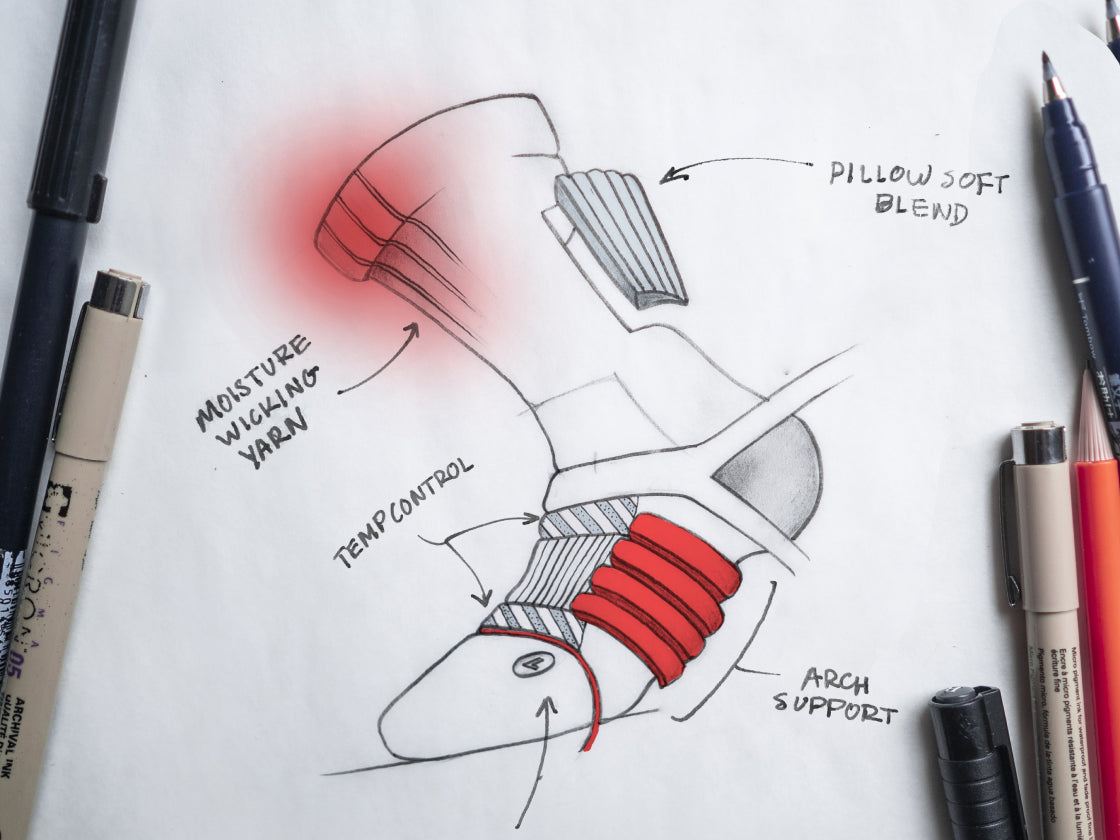
The Heel Strap handles the heel. The patented Strideline Heel Strap is a band knit around the heel pocket that wraps the ankle and Achilles. Strideline describes it as "fixed but flexible" support, holding the heel in place "without restricting axial movement." In plain terms, the sock's heel stays on your heel when you walk, cut, or climb stairs, and your ankle still bends freely. This is the feature that answers the tube-sock problem.
Direct Compression handles the arch and ankle. This isn't a medical compression sock. Strideline knits a firmer zone that, in the brand's words, hugs "the contour of the ankle" with "snugness without tightness and flexibility without slippage." It keeps the body of the sock positioned so the padding stays under your arch all day instead of drifting toward your toes.
Contour Fit handles the shape. Strideline knits with shape-memory fibers and labels each pair by foot, with a defined left and right, so the heel pocket, arch, and toe sit where your foot actually is. The shape-memory fibers are also what keep the sock recovering to its knit shape after a wash, which is the difference between a pair that stays up in month six and one that only stayed up in week one.
Quad-Ply Yarn handles the underfoot grip. The four-ply padding below the transverse arch and around the medial and lateral arches, with zoned cushioning at the heel and forefoot, gives the sock texture where your foot lands. It's there for comfort, but it also means the sock isn't a slick layer between your foot and the insole.
Sizing handles the rest. Strideline runs Small (men's 4–8), Medium/Large (8–12), and Extra Large (12–16), with women's Small (5.5–9.5) and Medium/Large (9.5–13) and youth sizes on the basics. The size guide says to size up if you're between sizes, which lines up with everything above: a sock at the top of its stretch is a sock that's trying to pull itself down.
Every one of these is in the everyday line. The Basic Crew Socks (from $14 a pair) are the reference point, and the same construction runs through the Basic Mid (from $12), Basic Ankle (from $12), and Basic No-Show (from $10.50) in The Basics, and up through the Performance Premium Crew 4-Pack ($54.99) and the Half Calf 8-Pack ($49.99). Strideline's technology page covers each feature in more detail, and the comfort guide explains how they add up to a sock you forget you're wearing.

Team Socks That Stay Up Too
Most licensed socks are novelty socks. The graphic is the product, and the construction underneath is a tube with a logo. They look right in the team store and slide down by the second quarter.
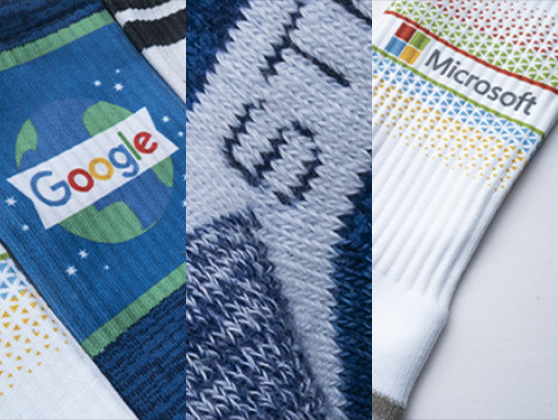
Strideline's licensed line is built the other way around. The Fan Wear collection covers officially licensed NFL, NFLPA, NCAA, MLS, MLBPA, and US Soccer styles, and the collection page describes them as "real team colors and authentic logos on our most comfortable build." That's the same Heel Strap, Direct Compression, and Quad-Ply Yarn construction as the basics, with sublimated graphics dyed into the knit rather than printed on top.
Two examples from the NCAA collection. The NCAA Half Calf 2-Pack ($19.99, two pairs) is the tallest cut in the licensed line, which matters for a sock that stays up: more fabric above the shoe means more for the sock to hold with, so it's the one for boots and high-tops at a cold tailgate. The NCAA Premium Crew Knit 3-Pack ($39.99, three pairs) is the sneaker-height version with the same heel and arch construction in a heavier knit. Both are available across more than 300 schools, and the NFL and MLS lines follow the same pattern.
The point isn't that team socks are special. It's that a logo should never be the reason you accept a sock that slides.
How to Tell in a Week Whether Your Socks Will Stay Up
You don't need a lab. A new pair tells you almost everything in the first wear and the first wash.
After the first wear, check three things when you take your shoes off. Is the heel of the sock still on your heel, or has it crept under your foot? Is the cuff where you put it that morning, or an inch lower? Is there a bunch of fabric under your arch? If all three are clean after a full day, the construction is doing its job.
After the first wash, follow the care label (Strideline's is machine wash cold, tumble dry) and then look at the pair next to an unwashed one. If the washed sock is noticeably wider at the cuff or longer in the foot, the recovery is weak and it will start sliding within a few weeks. If it's the same size and shape, it should hold.
Over the first month, the sock that stays up is the one you stop thinking about. If you're still tugging, go back through the list above: check the size against the chart first, then the height against your shoes, then the heel.
Before you buy the next pair, run the checklist. A knit-in heel pocket. Arch and ankle support in the description. Shape-memory or recovery fibers. A real size chart with your size on it. The right height for the shoes you actually wear. Cushioning in zones, not everywhere. A care label you'll follow.
If a sock clears all seven, it will stay up. Strideline's basics, performance line, and licensed team styles all do, which is why the construction is the same across every one of them. Start with a 3-pack from The Basics in your size and your shoe's height, wear them for a week, and check your heel at the end of the first day.
FAQ
How do I keep my socks from sliding down?
Start with the size: a sock that's too big bunches and a sock that's too small stretches and pulls down, so check the chart and size up if you're between sizes. Then match the height to your shoe, so there's enough sock above the top of the shoe to hold on. If the size and height are right and the sock still slides, the problem is construction: look for a knit-in heel pocket and arch support in your next pair.
What socks stay up the best?
Socks with a shaped heel pocket, a firmer knit through the arch and ankle, and stretch fibers that recover after washing. Strideline's socks use a patented Heel Strap around the heel and Achilles, Direct Compression through the ankle, and shape-memory fibers, and the same construction is in the basics, the performance line, and the licensed team styles.
Why do my socks keep falling down in my shoes?
Usually one of three things: the sock has no real heel pocket, so nothing anchors it; the size is wrong, so the fabric either bunches or is stretched to its limit; or the elastic has worn out from heat and age. A shoe that lets your heel lift will also pull a sock down with every step, and a sock that's too short for the shoe has nothing to hold with.
Do team socks stay up as well as regular socks?
They should, but many don't, because a lot of licensed socks are tube socks with a logo. Strideline's NFL, NCAA, MLS, MLBPA, and US Soccer styles use the same Heel Strap and Direct Compression construction as the everyday basics, with the graphics sublimated into the knit, so the heel holds the same way.
Should socks be tight to stay up?
No. A tight cuff rolls or leaves a mark and doesn't stop the heel from slipping. A sock stays up because the heel and arch hold it in place; the cuff should be snug enough to sit flat and no more. If you have to rely on a tight top band, the sock's construction is doing too little below it.